As could be predicted, attendance in class today was poor. Out of 8 or nine students in my class, only myself and one other girl showed up. After our midway break we decided that it was too damn hot to be inside and that we would go on an excursion. We packed up our stuff and the tree of us headed out to Buen Retiro Park.
I've been to the park when I was little and what I most remembered was the lake and eating potato chips at a plastic table in the shade. My teacher is a library of information about everything historic about Madrid so walking through the park with her was like having a private tour... in Spanish. :)
As we made our way through the park we would stop and ask questions and she would give us information about the park's history. I wish I could remember everything but it is impossible.
Parque Buen Retiro, was formerly the private resort/relaxation spot for royalty (all 350 acres of it!). Wikipedia has a really good summary of the changes within the park and how it progressed through out history, with wars and political movements.
In 1505, at the time of Isabella I (r. 1474–1504) the Jeronimos monastery was moved from an unsuitable location elsewhere to the present site of San Jeronimo el Real Church, and a new monastery built in Isabelline Gothicstyle. The royal family had a retreat built as part of the church.King Philip II (r. 1556–1598) moved the Spanish court to Madrid in 1561. Philip had the Retiro enlarged by his architect Juan Bautista de Toledo, and formal avenues of trees were laid out.The gardens were extended in the 1620s, when Gaspar de Guzmán, Count-Duke of Olivares, Philip IV's powerful favourite, gave the king several tracts of land in the vicinity for the Court's recreational use. Olivares determined to build, in a place that the king liked, a royal house which should be superior to those villas that Roman nobles had been setting up in the hilly outskirts of Rome during the previous century. Although this second royal residence was to be built in what were then outlying areas of Madrid, it was actually not far from the existing Alcázar or fortress residence, and the location in a cool, wooded area proved to be ideal.In the 1630s, under the supervision of architects Giovanni Battista Crescenzi and Alonso Carbonell, several building were erected in great haste, two of which are still standing: the "Casón del Buen Retiro" which served as a ballroom, and the building that today houses the military museum, the Museo del Ejército, which includes the grand entrance hall, the "Salón de Reinos" (Hall of Kingdoms), its wall decorated with paintings by Velázquez andZurbarán and frescoes by Luca Giordano.[1]The Count-Duke of Olivares commissioned the park in the 1630s, worked on by Cosimo Lotti, a garden designer who had worked under Bernardo Buontalenti on the layout of the Boboli Gardens for Cosimo I, Grand Duke of Tuscany. Water was a distinguishing trait of the garden from the outset: the great pond, Estanque del Retiro, which served as the setting for mock naval battles and other aquatic displays, the great canal, the narrow channel, the chamfered or bellflower pond, created —along with the chapels— the basic layout of the gardens. Buen Retiro was described as "The world art wonder of the time", probably the last great creation of the Renaissance in Spain. Buen Retiro became the center ofHabsburg court life at a time when Spain was the foremost power in the world. During the reigns of Philip IV and Charles IIseveral magnificent plays were performed in the park for the royal family and the court.The gardens were neglected after the death of Philip IV in 1665, but have been restored and changed on many occasions, notably after being opened to the public in 1767 and becoming the property of the municipality in 1868.[2]Philip V (1700–1746) ordered the creation of a parterre, the only French-style garden in the complex. During the reign ofFerdinand VI, Buen Retiro was the setting for magnificent Italian operas. Charles III (1759–1788) saw to the beautification of its perimeter, replacing the old walls with elegant wrought-iron railings. Juan de Villanueva's Astronomical Observatory was built during the reign of Charles IV (1788–1808).The Buen Retiro Palace was used until the era of Charles III. Most of the palace was destroyed during the Peninsular War(1807–1814) with the First French Empire.The reign of Queen Isabella II saw profound changes in the "Retiro". During the queen's minority, the gardens enjoyed a particularly prosperous period, with the planting of shade and fruit trees, and previously unplanted areas like the "Campo Grande", were landscaped as well. The gardens eventually passed to public ownership in 1868, at the time of the overthrow of Queen Isabella.El Retiro gradually became the green heart of the city. At the beginning of the 20th century, the monument toAlfonso XII was erected next to the pond, designed by architect José Grases Riera. Countless statues, fountains and commemorative monuments have filled the park and converted it into an open-air sculpture museum.The nineteen-thirties and forties witnessed the creation of new gardens attributed to Chief Gardener Cecilio Rodriguez who designed and built the rose bed and the gardens that have been named to honor him.
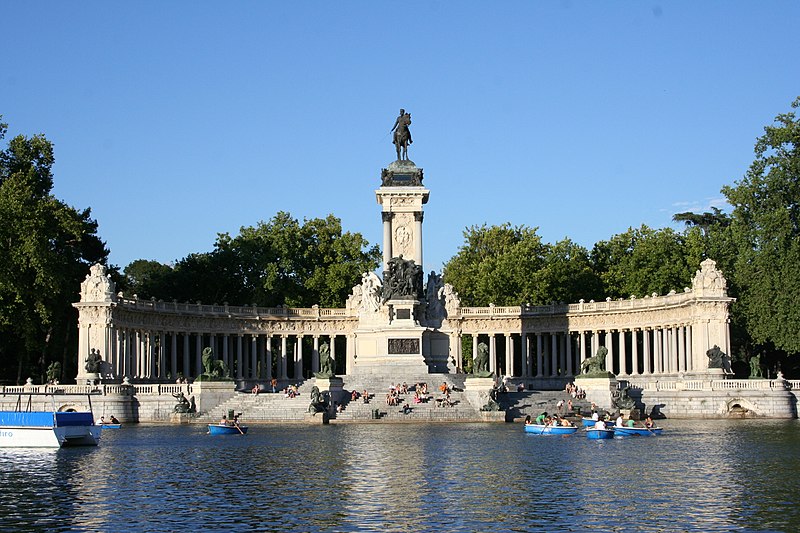
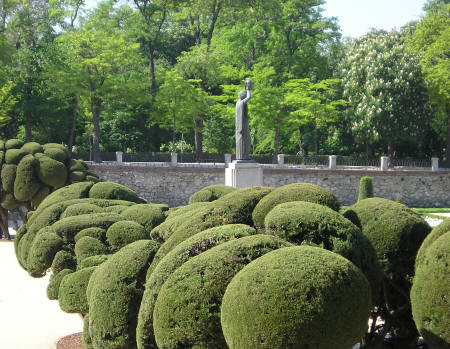
Mind you, our walk took place at midday so it was freakin hot...but we still managed to make the most of our outing. We saw the Monument to Alfonso XII and all sorts of topiary and sculpted gardens.


.JPG)
We ended our walking tour in front of one of the entrances to the Prado Museum where there is a recently restored San Jeronimo el Real Cathedral. It was neat to see a cathedral look so new, like it was newly erected.
And now for something completely different:
In doing some research about the details of Retiro Park for this blog I came across this music video that boasts that the majority of it is filmed in Retiro Park. I was intrigued. I listened. I cringed. I had to share it.
The poor dancing, awkward angles and the fact that the singer resembles a certain family member of mine (and is exactly how I picture he would sing) is simply the icing on the cake. Let me know what you think! :)

oh my god this is the most hilarious music video I've ever seen. And the WORST singing and worst dancing and worst looking man in the world!
ReplyDeleteYay! Laura, I had to force myself to watch it all the way through but I am glad that you liked it as much as I did.
ReplyDelete